

What to Do With Old Catering Equipment: Sell It, Scrap It, or Skip It
Skipping old commercial catering equipment is usually illegal and pays almost nothing. What UK law says, what scrap really pays, and the better option.
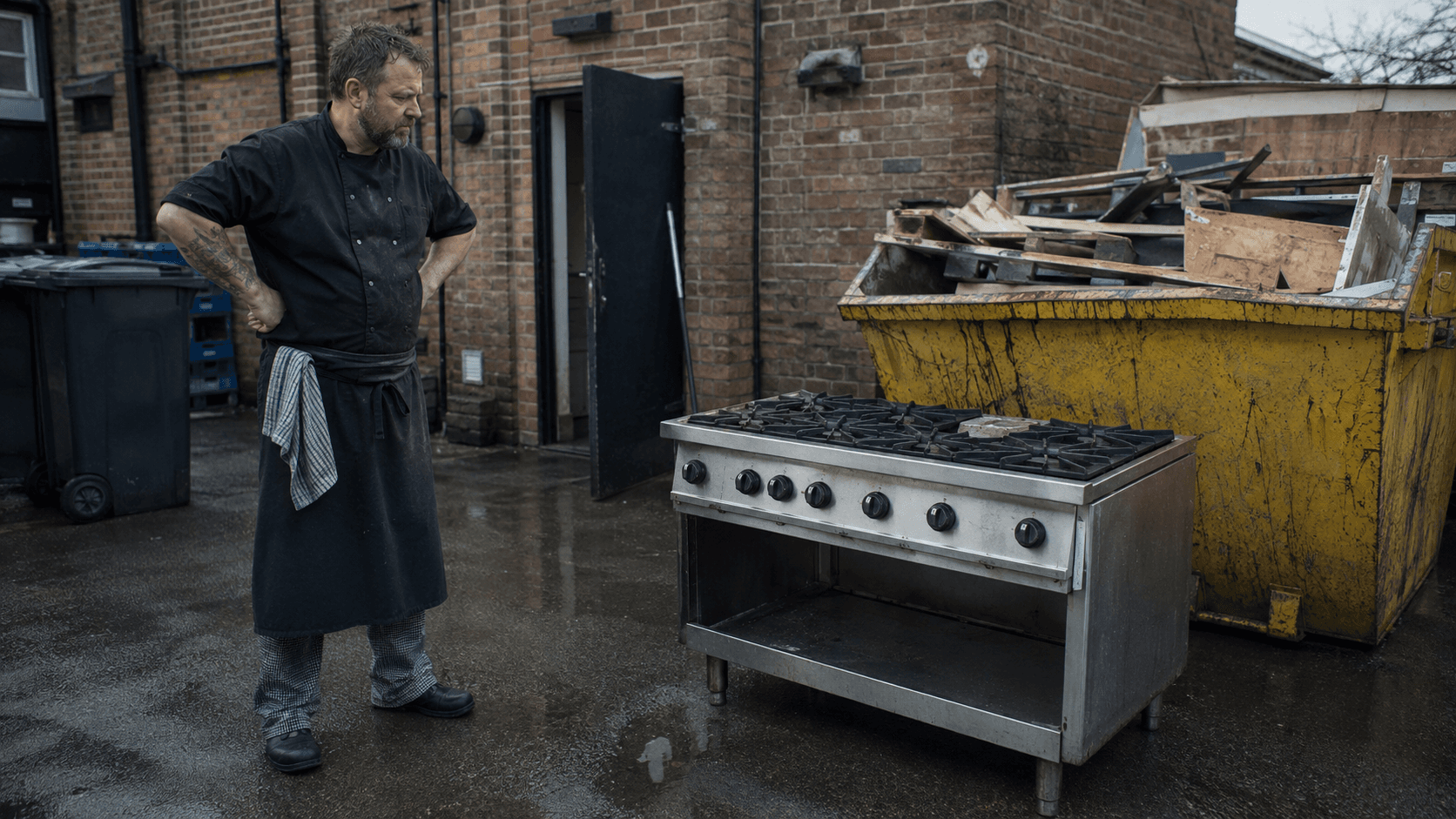
Before you pay anyone to take an old machine away, ask who supplied its replacement. Under the WEEE rules the producer of the new kit often has to finance disposal of the old one.
Every kitchen reaches the day when a machine has to go. The usual thinking is that selling it is a fortnight of messing about, so it goes in the skip and the yard is clear by Friday.
That instinct is understandable and it is almost always wrong, for three separate reasons. Skipping most commercial catering equipment is not legal. Scrapping it pays far less than people imagine. And the machine standing in your yard is very often worth real money to another kitchen exactly as it is.
Here is what each of the three options actually looks like in 2026.
What Scrapping Actually Pays
This is the number that changes minds, so it is worth doing the arithmetic properly rather than guessing at it.
A whole appliance weighed in unstripped is not stainless scrap. In the trade's own grading it falls in the light iron band, alongside pressed white goods. In July 2026 that grade was published at £60 to £90 per tonne.
Now the weights, taken from manufacturer specifications: a Falcon Dominator Plus six burner gas range is 109kg. A Foster EcoPro upright fridge is 99.5kg. A Classeq pass-through dishwasher is 130kg.
So, as a calculation from those published figures rather than a quote anyone has given:
- Six burner range, 0.109 tonnes at £60 to £90 a tonne: roughly £6.50 to £10
- Upright fridge, 0.0995 tonnes: roughly £6 to £9
- Pass-through dishwasher, 0.130 tonnes: roughly £8 to £12
Before transport. Yards generally want at least 200kg to justify a visit, so one machine is half a load. And before any degassing cost on refrigeration, which is covered below.
Even the theoretical ceiling, pretending an entire appliance were clean sorted 304 stainless, tops out around £70 to £90 on the heaviest item, and no appliance is anywhere near all stainless once you account for the cast iron pan supports, the compressor, the motor, the insulation and the plastics.
For scale in the other direction: landfill tax from 1 April 2026 is £130.75 per tonne, which is roughly double what light iron pays. Getting rid of a tonne of mixed catering steel is a cost line, not a payday.
You Mostly Cannot Legally Skip It Anyway
It is electrical waste. Commercial catering equipment falls under the WEEE Regulations, and government guidance names "large capacity catering and laundry equipment designed specifically for the commercial sector" as a business to business example. One useful exception for our trade: a gas appliance is only classed as electrical equipment if it needs electricity to work properly. A gas range whose burners are controlled electronically is in scope. One that runs as a gas cooker with nothing but a spark ignition is not.
Anything with a refrigerant in it is hazardous waste, classified under code 16 02 11, and it carries a second duty that catches people out. Under the F-gas rules, recovery of the refrigerant before disposal is mandatory, it must be carried out by someone holding a current F-gas certificate, and there is no minimum charge size below which the duty falls away. The leak-checking thresholds people quote do not apply to recovery. Critically, the legal duty to make sure it happens sits on the operator, which means the owner of the machine, not the man with the van who takes it away. The published maximum civil penalty for failing to recover is £100,000, and the same maximum applies to deliberately venting gas to atmosphere.
Fridges, freezers and electricals are excluded from standard skips for exactly these reasons.
And your duty of care does not end when the lorry pulls away. Under section 34 of the Environmental Protection Act 1990 you must transfer waste only to an authorised person, with a written description, and take reasonable measures throughout. In practice that means checking the carrier's registration number on the public register, keeping a waste transfer note for two years, or a hazardous waste consignment note for three years on anything with refrigerant in it. Failing to produce transfer documents when required carries a £300 fixed penalty. If waste you handed over is later fly-tipped and you took no reasonable steps, you are exposed as the producer, and the statutory Code of Practice states plainly that there is no upper limit on the court's power to fine for a duty of care offence.
One change worth knowing about: the Digital Waste Tracking service went live on 28 April 2026 and becomes mandatory for licensed sites receiving waste from October 2026, with carriers following in October 2027. It does not replace waste transfer notes, so keep doing the paperwork as normal.
The Rule Almost Nobody Uses: The Producer May Have to Pay
This one is worth the price of the whole article.
Under regulation 12 of the WEEE Regulations, the producer finances the collection, treatment and disposal of business equipment placed on the UK market on or after 13 August 2005. For older equipment placed on the market before that date, the producer of the new replacement picks up the cost, provided the new machine is of an equivalent type or does the same job.
So if you are replacing a machine, the disposal of the old one is very often not your bill at all. Ask the supplier of the new one before you pay anyone to take the old one away, and note that the relevant date is when the equipment was first placed on the market, not when you bought it. A 2003 oven you picked up second hand in 2019 is still pre-2005 equipment.
The end user only carries the cost where the kit is pre-2005 and nothing is replacing it, or where a different arrangement has been agreed in a contract.
Sell It, and the Paperwork Disappears
Here is the part that makes the decision easy. Equipment only becomes waste when the holder discards it, intends to discard it, or is required to discard it. Equipment that is tested, working, invoiced to a buyer who wants to use it, and moved as goods rather than as waste is not waste at all, and none of the duties above apply. The Regulations recognise this directly: the treatment requirement does not apply to equipment reused as a whole appliance.
Selling working kit does not just pay better than scrapping it. It takes you out of the disposal chain rather than paying to enter it.
The trade rule: if it still runs and it carries a badge with a UK parts network behind it, Rational, Foster, Williams, Hobart, Lincat and their like, it is worth more to another kitchen than it will ever be worth to a scrap merchant. That is not sentiment, it is because those machines are built to be maintained, and a buyer knows a seal or an element will turn up next day. Our guide to finding catering spares in the UK covers why that badge decides everything.
Even a dead machine is not automatically scrap. Listed honestly as spares or repair with the fault stated plainly, it is a donor unit for somebody running the same model, and donor machines sell.
So Why Does Good Kit End Up in a Skip?
Because selling it on a general marketplace is genuinely miserable. Endless messages from people who have no intention of buying, questions from somebody who thinks a combi oven will fit in a Corsa, and a fortnight of that while the machine sits in the way.
That is a real problem and it is worth naming honestly rather than pretending it is not the reason. It is also the specific problem a trade-only marketplace exists to solve: on a site that carries nothing but UK commercial catering equipment, everybody browsing is looking for the same category of thing you are trying to move.
The Checklist for the Machine in Your Yard Today
- Photograph the data plate before you do anything else, model and serial
- Does it still run? If yes, price it against the used market before you price it against the skip
- Are you replacing it? Ask the new supplier who finances disposal of the old one under WEEE
- Anything with refrigerant in it: book a certificated F-gas engineer, do not let it go anywhere ungassed
- If it is going as waste, check the carrier's registration number on the public register and keep the transfer note
- If it is not going as waste, sell it as goods with an invoice and the duties never arise
Don't Skip It
A commercial machine with a parts network behind it is never really finished, it is between kitchens. BUY • SELL • SAVE works because the kit lasts, and every machine that goes in a skip is somebody else's next fifteen years thrown away for the price of a round of drinks.
Ready to Move It On?
If you have kit standing in the yard, list it on CaterBids rather than binning it. Spares or repair listings are welcome when the fault is stated honestly. Your first listing is free while our launch offer lasts, then from £5 for 30 days. No commission and no final value fee. Or browse the marketplace if you are on the other side of it, and if you are clearing a whole site rather than one machine, start with our guide to selling up when a restaurant closes.
Ready to Sell Your Equipment?
Your first listing is free while our launch offer lasts, then from £5 for 30 days. No commission and no final value fee, so what a seller makes is what they keep.
Prepare Your Equipment
- Clean stainless surfaces
- Disconnect safely
- Photograph the data plate
- Box loose parts
- Measure and weigh
- Prepare for pallet collection