

How to Send Catering Equipment on a Pallet Without Breaking It
Pallet delivery for catering equipment: sizes, weight bands, how to wrap it, tail-lifts and fridges. What gets refused at collection and why. CaterBids.
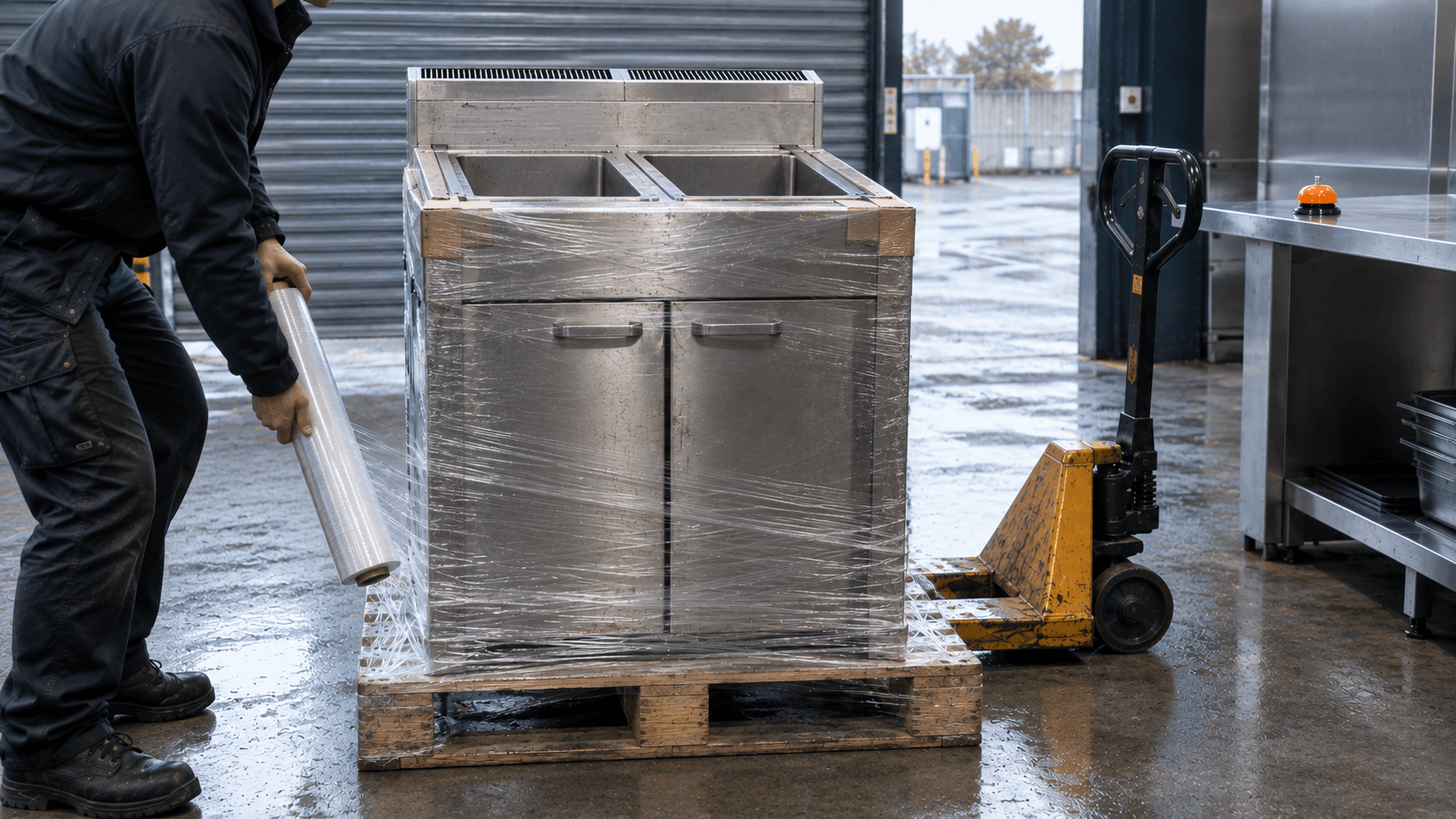
Once it's wrapped, take one photo of the finished pallet with a tape measure stood against it showing the height, and one of the scales or the data plate showing the weight. If the courier disputes the size or weight, or anything turns up damaged, you've got the proof in ten seconds.
Most used catering equipment never leaves the town it was bought in. Not because nobody further away wants it, but because the seller has no idea how to get a 90kg fryer to Leeds, and the buyer assumes it can't be done. So the kit gets sold cheap to whoever can turn up with a van.
Pallet delivery fixes that. A properly prepared pallet goes through the same national networks that move every other kind of freight in the UK, usually in two or three working days. The catch is the word "properly". A badly prepared pallet doesn't just risk damage. The driver can refuse to take it, and you've lost a day and the buyer's patience.
This is how to do it right, from someone who has spent 25 years moving commercial kitchen kit in and out of buildings.
Know Your Pallet Before You Book
- UK or Euro: a UK standard pallet is 1200mm by 1000mm. A Euro pallet is 1200mm by 800mm. Either works for most single machines. Nothing may hang over the edge, so measure the machine's footprint first.
- Height includes the pallet: an empty wooden pallet is about 150mm tall, and every height limit counts it. A full pallet is normally capped at 2.2m from the floor, and the smaller bands are much lower. Measure the loaded height, not the machine.
- Weight decides the band: couriers sell pallet space in weight bands. On the Interparcel quote tool, for example, a Quarter takes up to 300kg, a Half up to 500kg and a Full up to 1,000kg. Most single catering machines sit in the Quarter or Half band.
- Weigh it or read the plate: under-declaring weight is the commonest mistake, and it earns a surcharge or a refusal. The data plate or the manufacturer's spec sheet will give you the weight if you don't have scales.
Where to Get a Pallet
Check out the back first. Most kitchens, pubs and cash and carries have spares. They turn up free on local marketplaces constantly, and pallet suppliers sell them for a few pounds. Reject any with broken boards, missing blocks or nails sticking up. The pallet is carrying your machine and your reputation.
Getting the Machine On
- Never drag it on its edge: tipping a machine on one corner to walk it along twists the frame and cracks welds. Use a pallet truck, a sack truck with a strap, or two people and a lift.
- Centre the weight: the pallet tilts when it's lifted, so the heavy end of the machine goes in the middle, not hanging off one side.
- Feet on timber, not gaps: stand the machine's feet or base on the deck boards, not across the gaps between them.
Preparing the Machine Itself
- Drain everything: fryer oil, bain marie water, dishwasher sumps, water boiler tanks. Liquids leak, and a leak can ruin the whole consignment on the lorry.
- Bag loose parts: baskets, shelves, grill bars, burner caps and knobs go in a bag or box taped inside the machine. Loose parts go missing.
- Tape doors and lids shut: use tape that won't mark stainless.
- No gas bottles: LPG cylinders don't travel on a standard pallet service. Disconnect and remove them.
- Photograph it: take photos of every side before it's wrapped. If anything arrives damaged, those photos are your evidence.
Wrap It to the Pallet
All you need is a roll of stretch wrap. Any cash and carry or packaging supplier sells it, and one roll does several machines.
The wrap has to hold the machine and the pallet together as one lump, so start at the pallet, not the machine. Tie the end of the film to a corner block of the pallet, then go round the deck boards three or four times before you start climbing up the machine. Pull it tight on every pass.
Work up the machine and back down again, overlapping each pass by about half. For a heavy machine, four to six passes is about right, with extra at the base. Finish by going round the pallet deck again a few more times.
Put a bit of folded cardboard on any sharp corners first so the film doesn't split. Wrap that stops above the pallet is the thing drivers look for, because it means the machine can slide off.
Refrigeration Travels Upright
Fridges, freezers and prep counters go upright, every time. Laying one on its back can push compressor oil into the pipework, and switching it on too soon afterwards is how compressors die. If a unit has had to go on its side, stand it upright and leave it several hours before switching on. One commercial maker says at least six. Many engineers say 24 to be safe. Also leave the doors open for a day before it's wrapped, so it's dry inside.
Collection and Delivery Day
- Tell the courier the truth about access: pallet deliveries use big vehicles, some up to 18 tonnes. Narrow lanes, low bridges and no parking all need mentioning when you book, or you'll pay for a second attempt.
- Kerbside means kerbside: the driver uses a tail-lift and pallet truck to get the pallet to the ground and as close as the surface allows. They won't take it inside, up steps or through a building.
- Hard, level ground only: pallet trucks don't work on gravel, grass, cobbles or slopes. A kitchen at the end of a gravel drive needs a plan before the lorry arrives.
- Check the cover: standard transit cover on pallet services is often only around £25. On a £2,000 combi, pay for the extra cover. It costs little and it's the difference between a claim and a loss.
When a Pallet Is the Wrong Answer
A pallet isn't right for everything. Anything wider than the pallet, a full cook line, a walk-in cold room, or a catering trailer needs a specialist or a man and van. And for a light, small item under 30kg, a normal courier parcel is cheaper.
Your Pallet Checklist
- Measure the footprint, loaded height and weight
- Check the pallet for broken boards and nails
- Drain every tank and remove any gas bottle
- Bag loose parts and tape doors shut
- Photograph every side
- Wrap it tight, starting and finishing round the pallet boards
- Book with honest access details and proper cover
Get those seven right and a machine that would have sold cheap to a local buyer can sell at a fair price to someone at the other end of the country. That's the whole point. BUY • SELL • SAVE.
Ready to Sell to Buyers Beyond Your Postcode?
Your first listing is free, one per account, then from £5 for 30 days. No commission and no final value fee. Photograph the data plate and CaterBot fills in the specs, dimensions and weight, which is exactly what a pallet quote needs. For more on the delivery options, see our Delivery Guide, or list your equipment on CaterBids.
Ready to Sell Your Equipment?
Your first listing is free, one per account, then from £5 for 30 days. No commission and no final value fee, so what a seller makes is what they keep.
Prepare Your Equipment
- Clean stainless surfaces
- Disconnect safely
- Photograph the data plate
- Box loose parts
- Measure and weigh
- Prepare for pallet collection