

Mobile Coffee Catering Vans, Carts and Trailers: The Checks Before You Pay
Buying a used coffee van, cart or trailer? The papers to ask for, the espresso, gas, power and towing checks, and what to register before you trade.
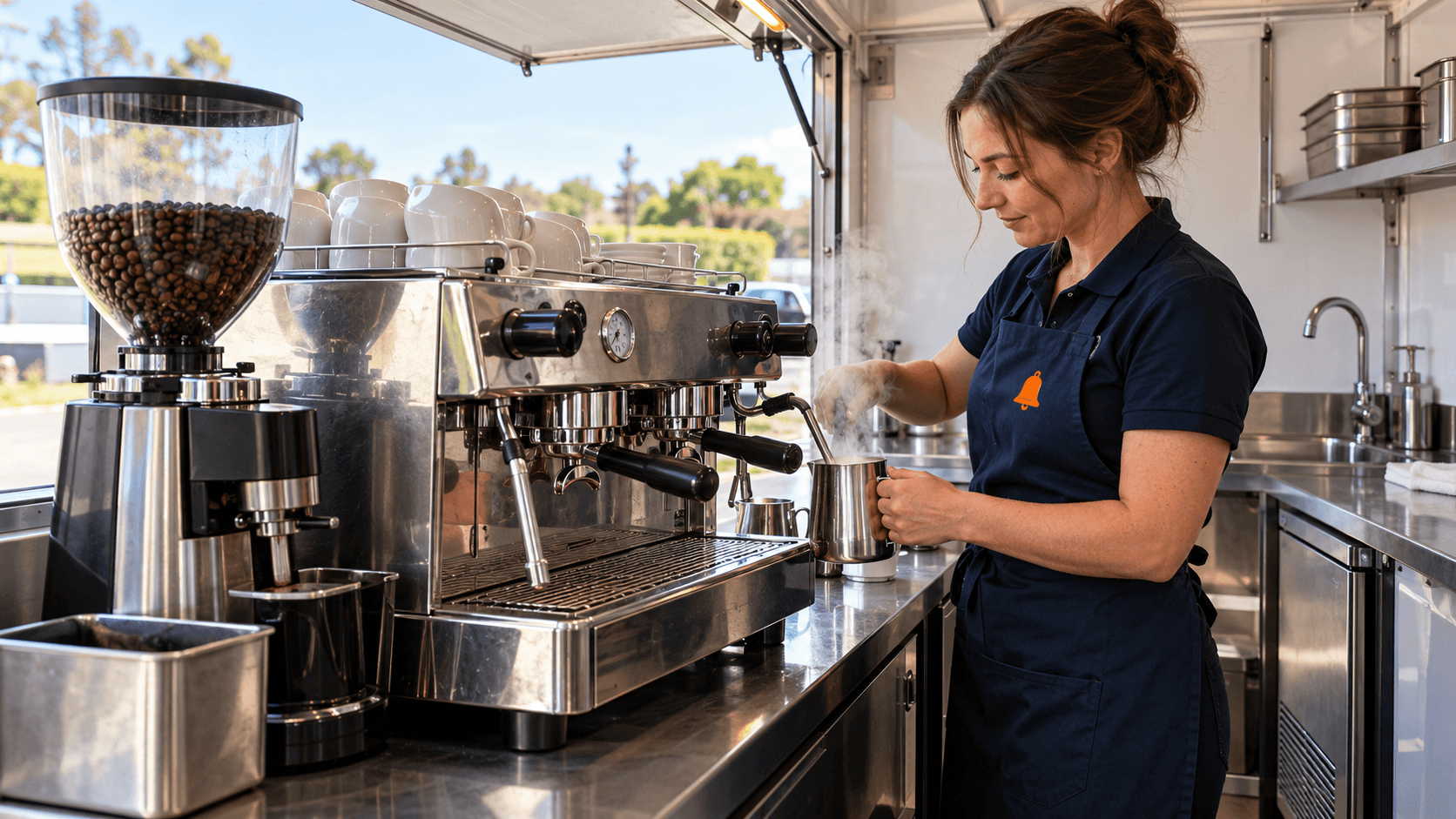
Ask for the gas certificate, the espresso machine's pressure examination report and the MOT history before you view. A seller who can't send them is selling a project.
Quick answer: Before you pay for a coffee van, cart or trailer, ask to see the gas safety certificate for the unit, the latest pressure examination report for the espresso machine, and the MOT history if it has an engine. Then make sure your licence lets you tow it, and register with your council at least 28 days before your first day of trading. A unit that can't show those papers is a project, so offer like it is one.
Van, trailer or cart: pick the right one first
The three do the same job in very different ways. Choose the one that fits how and where you will trade, then check it properly.
| What it is | How to spot it | Who it suits |
|---|---|---|
| Coffee van | Built into a vehicle with its own engine, number plate and serving hatch | Traders who move site most days and want one vehicle to drive and serve from |
| Coffee trailer | No engine, a tow hitch and jockey wheel, serving hatch down one side | Traders who park up for a full day or weekend and already have a tow vehicle |
| Coffee cart | A small unit pushed by hand or wheeled into place, no engine and no hitch | Indoor sites, stations, offices and events with power and space set aside |
Check the espresso machine and its paperwork
The Health and Safety Executive lists a steam coffee machine as an example of a pressure system. The rules cover systems holding a relevant fluid above 0.5 bar. The user must have it examined by a competent person, to a written scheme of examination.
Ask the seller for that scheme and the most recent examination report. If neither exists, budget for an examination before you serve a single cup. The duty becomes yours the day you start using it.
Then run the machine from cold. Watch it reach pressure, pull a shot on every group and steam milk on every wand. Look under the drip tray and behind the panels for scale, water marks or drips.
Check the grinder too: noisy burrs or uneven grounds mean parts. For a fuller run-through of the machine itself, see our used commercial coffee machine guide.
Check the gas
Most mobile units run something on LPG, even if it is only a water heater. Ask for the current gas certificate for the whole unit, not one appliance.
The engineer who signed it must be on the Gas Safe Register and qualified for LPG and for the type of appliance fitted in mobile catering. Being registered does not cover every job, so check the categories on the register or on the back of their ID card.
See where the cylinders sit and how the gas is piped to each appliance. Look for perished hoses, missing clips and anything rigged up since the last check. Our guide to gas safety on second-hand catering equipment covers what a proper certificate should show.
Check the power and water
Ask how the unit was run day to day: a generator, a battery system or a hook-up at each pitch. Then switch everything on at once from that power source: espresso machine, grinder, fridge, water heater and lights together. If it trips or the generator labours, you have found your first cost.
Ask the seller what supply the espresso machine needs, and make sure your power source can meet it at full load, not just on standby.
Run the water system. Fill the tanks, listen for the pump, and check that hot water reaches the hand wash basin as well as the machine. Ask your council's food safety team what they expect for hand washing before you buy, not after.
Check the vehicle or trailer
For a van, put the number plate into the free GOV.UK MOT history check. It shows passes and fails, the mileage at each test, failed items and minor faults.
For a trailer, check your licence first. A car licence gained on or after 1 January 1997 lets you tow a trailer of up to 3500kg maximum authorised mass (MAM). The trailer's MAM is normally on a plate or sticker on the trailer, and your car's limit is in its handbook.
Then look at the basics on any base: tyres, lights, hitch, brakes, and the floor in front of the hatch, where water and foot traffic do the most damage.
Before your first day of trading
Register as a food business with your local council at least 28 days before you start. It is free and it can't be refused. Register where the unit is based, then add each fixed pitch if your council asks.
In England and Wales you may also need a street trading licence from the council where you want to trade. The council can refuse it, cut the days or put you on a waiting list. Trading without one when it is needed can lead to a fine, so check before your first pitch.
Events and private sites set their own rules. Ask the organiser what papers they want to see, then gather them before you agree a price on the unit.
Where to find one
Browse used catering equipment for sale across the UK, or go straight to catering vans and trailers to see what is listed now.
Selling your old unit to fund the new one? Your first listing is free while our launch offer lasts, then from £5 for 30 days. No commission and no final value fee.
Sources
- HSE: introduction to pressure equipment
- HSE: using pressure systems
- HSE: written schemes of examination
- NCASS: finding a qualified mobile catering gas engineer
- GOV.UK: check the MOT history of a vehicle
- GOV.UK: towing with a car
- GOV.UK: towing weights and dimensions
- GOV.UK: starting a food business
- GOV.UK: street trading licence
- CaterBids: seller pricing
Ready to Sell Your Equipment?
Your first listing is free while our launch offer lasts, then from £5 for 30 days. No commission and no final value fee, so what a seller makes is what they keep.
Prepare Your Equipment
- Clean stainless surfaces
- Disconnect safely
- Photograph the data plate
- Box loose parts
- Measure and weigh
- Prepare for pallet collection