
Used Commercial Coffee Machine Buying Guide: What to Check Before You Buy
Before you buy a used commercial coffee machine, check the water it ran on, the power it needs and the service history. All three covered here. CaterBids.uk
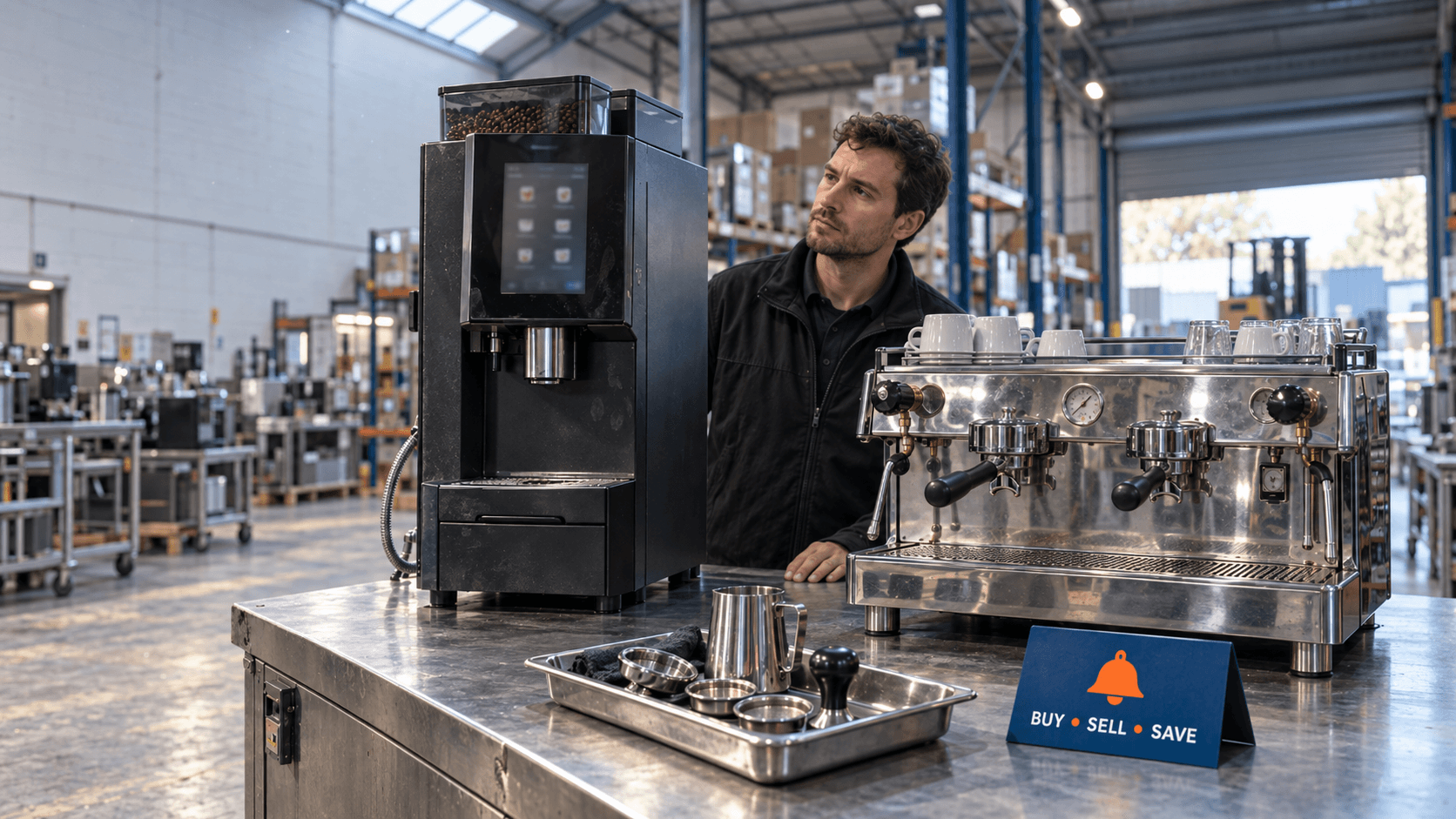
Read a service folder for its pattern, not its thickness. Three different firms and an unexplained gap tell you more about a used coffee machine than any photograph a seller sends you.
The coffee machine is one of the highest margin lines a catering business runs. What goes in the cup costs very little and the price on the board does not, so a machine that works pays for itself every day it is on. It is also one of the biggest single outlays on the counter.
Buy the wrong one and it sits idle burning capital, or it fails on a Monday morning on the one thing the whole site depends on. Used is the sensible route for most operators: these machines run for years and the trade sells them on constantly. What separates a good buy from an expensive one is knowing what to look at before the money moves.
Bean-to-Cup or Traditional Espresso: Know Which One You Are Buying
These are two genuinely different machines for two different kinds of site, and the rest of the decision follows from it. A traditional espresso machine is long, low and horizontal: group heads along the front face, portafilters with black handles locked into them, a steam wand at each end. It makes very good coffee and it needs somebody who can use it. No trained barista on the rota, no result.
A bean-to-cup is the opposite shape. A tall vertical unit, bean hopper on top, touchscreen on the front, spouts at cup height, grinding and brewing and steaming on one press. Built for self-service, and for sites where nobody is going to be trained to pull a shot.
Sizing is one idea under two names. Group head count on a traditional machine decides how many drinks come out at once, so match it to your busiest half hour rather than to the lowest asking price. On a bean-to-cup it is the spout count and the hopper capacity, because a machine refilled mid rush holds the queue up.
A cafe with staff who can pull a shot wants traditional. A forecourt, an office, a hotel lobby or a self-service counter wants bean-to-cup. Get the shape wrong for the site and you have made the most expensive mistake on this page before anybody has looked at condition.
What a Used Coffee Machine Is Actually Worth
There is no universal price for a used commercial coffee machine, and anybody who offers you one is guessing. What exists instead is a list of things that move the number, and the two sections below take them in turn.
We have set out new against used already. The only prices here are the two further down: two sellers' asking prices on a fixed price marketplace, not a market average.
What to Check Before You Hand Over Any Money
- Match the Photo to the Machine: ask for a current photo of the actual unit, not a stock image, and check the brand and model in it match the listing. Not every listing gets this right.
- Ask for the Descaling and Service History: get it before you travel, and read it rather than counting the pages.
- Check the Group Head or Spout Count: it sets how many drinks come out at once, so buy for the volume you actually do.
- Ask About Spares: a brand nobody stocks parts for is a machine you cannot keep running, so settle that first and find the right part before you write it off second.
- Confirm the Phase and the Water Point Before Delivery Day: not on the day, and not after it.
Water Hardness, Scale and Power: What Actually Kills These Machines
Twenty five years in commercial kitchens tells us this is the section to read twice. Almost every used coffee machine that disappoints somebody fails on one of three things, and all three can be checked before the money moves.
Water first. Limescale kills a coffee boiler faster than anything else in the kitchen, because the machine holds hot water at temperature all day instead of heating it in bursts. Scale builds on the element until it insulates it, the element then works harder and hotter for the same job, and the machine loses either its temperature stability or the element itself. The same deposits fur up the group head circuit and chew through seals. We have covered what limescale does to a machine that holds hot water all day already.
What matters when buying is the water it came off and the water it is going onto. Incoming supply needs to be WRAS compliant, and in a hard water area a softener or reverse osmosis unit is part of the installation, not an optional extra. Ask three things. Was it on a softener. When were the cartridges last changed. Has the boiler ever been descaled, and has it ever been replaced. A machine out of a hard water area with no softener history is one you price as though the boiler needs work.
Power second. We have the difference explained in full elsewhere, so here is the coffee version. Bigger multi group traditional machines are commonly three phase, while plenty of bean-to-cup units and smaller espresso machines run single phase. The mistake that costs real money is buying a three phase machine into a single phase unit and finding out on delivery day, machine on the pavement, seller at the other end of the country. Read the data plate rather than the listing text, then check what is on the wall at your site. If you are not certain, get a qualified electrician to look before you buy.
Service history third, and most buyers treat it as a tick box. A folder is not a pass. Read it for the pattern. Has the same engineer been back at regular intervals, or is it three firms and a gap nobody explains. Does descaling appear as a routine line, or once, straight after a fault. Were parts replaced with the right part, and was the last visit a service or a breakdown call paid for in a hurry. A thick folder of breakdown callouts is worse news than a thin folder of routine services. No paperwork is not automatically a no, but it moves the price, and you buy as though every wear part is due.
Two Machines Listed on CaterBids Right Now
Two Featured listings show both ends of this decision.
The first is "4x Rex Royal S300 Bean to cup machines, milk fridges and cleaning kits and manuals", listed at £5,495, collection only from the seller's own location in Bedford. Four machines in one go is a multi site or dealer buy rather than a single replacement.
The second is "Ready To Trade Coffee Business. Just Tow and Trade.", listed at £16,000, collection only from the seller's own location in Solihull B90. That is the other end of the same decision, and buying a trading business is a bigger question than buying a machine, which we have set out in what actually transfers.
Both are Featured listings on a fixed price marketplace, so the asking price is the price. Both can also sell, so check the live listing before you plan a journey.
The Checklist Before You Buy
- Decide bean-to-cup or traditional, and the group head or spout count your actual volume needs
- Ask whether it ran on a softener, and when the cartridges were last changed
- Get the descaling and service history, and read it for routine services rather than breakdown callouts
- Check the phase and voltage on the data plate against what is on the wall at your site
- Match the machine in the photos to the one named in the listing
- Ask about spares availability for that make and model
- Confirm the water and drainage point is ready before delivery day, and get a delivery quote before you buy
Work through that and a used commercial coffee machine stops being a gamble and starts being equipment you have properly assessed.
Ready to See What Is Listed Today?
Coffee and Bar Equipment has its own category on CaterBids, alongside everything else the trade is clearing and replacing. Browse what is listed today. And if you are clearing coffee equipment as well as buying it, your first listing is free, one per account, then £5 for 30 days, with no commission and no final value fees, so what you sell it for is what you keep. BUY • SELL • SAVE.
Ready to Sell Your Equipment?
Free to list while the first hundred listings are running, then from £5 a listing, and no final value fee at any point, so what a seller makes is what they keep.
Prepare Your Equipment
- Clean stainless surfaces
- Disconnect safely
- Photograph the data plate
- Box loose parts
- Measure and weigh
- Prepare for pallet collection