

Commercial Kitchen Gas Interlock: What Has to Be Right Before Your Engineer Signs It Off
Buying used gas catering equipment? Your Gas Safe engineer signs off the ventilation too. What the interlock and canopy must do before it lights.
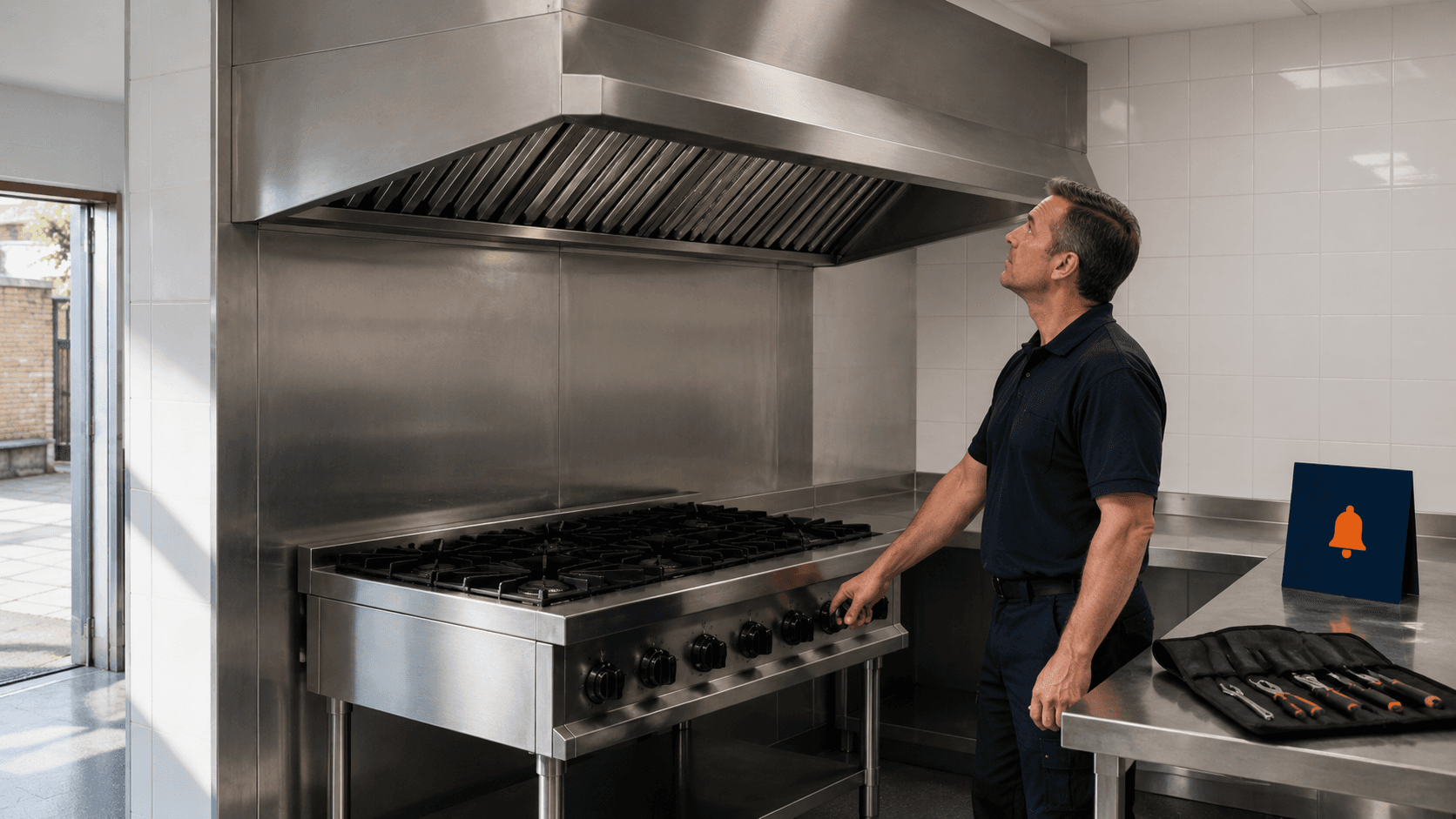
Measure your cooking line before you shop, not after. A canopy 200mm too short cannot be signed off, and you will be buying it twice.
Nobody Checks What You Buy. One Man Checks Whether It Lights
You can buy any piece of used gas catering equipment in this country. Nobody stops you. There is no inspector at the point of sale, no certificate that comes with the machine, no test before the money leaves your account.
The check happens later, in your kitchen, when a Gas Safe registered engineer comes to commission it. And here is the part most buyers do not know until it costs them: he is not only passing off the appliance. He has to satisfy himself the ventilation serving it is right as well, because under BS 6173 that check is part of commissioning the appliance, not somebody else's job for another day.
If it is not right, he cannot sign it off. That is not him being awkward. It is his registration on the line.
What He Is Actually Checking
- The interlock exists and works. HSE guidance is plain: the installer should have fitted an interlock between the mechanical ventilation and the gas appliances, so that failure of the ventilation shuts the gas off. It is normally done with a differential air pressure switch proving airflow, or a current sensor on the fan. Either way the gas cannot flow unless the extract is running.
- Nobody has fitted a bypass. HSE is explicit that manual bypasses to interlock systems are not permitted. A switch that lets someone cook with the fan off is not a workaround, it is a fail.
- There is enough replacement air. Extract without make-up air starves the room. Environmental health guidance is clear that it is not acceptable for replacement air to be drawn in through doors, so if the design relies on a propped fire door, it does not count.
- The canopy actually covers the equipment. Per DW/172, the canopy should extend at least 300mm beyond the front and exposed sides of the cooking equipment, with baffle filters set at 45 to 60 degrees and the underside around 2m off the floor. Over a combi or anything else throwing a heavy plume, more than the minimum is worth having.
- The appliance itself is sound and suited to the room. Age is not a fault. Missing flame supervision, a damaged flue, or a machine that was never designed for the space it is now standing in, those are faults.
Why the Canopy Fails More Often Than the Machine
Hot air off a range does not rise in a neat column. It entrains cool room air and spreads outward as it climbs, so by the time it reaches canopy height it is wider than the appliance that produced it. Add the cross draughts every real kitchen has, a door propped open, staff crossing behind the line, and it spreads wider still.
A canopy cut flush to the front of the range is therefore behind the problem before it starts. The plume has already spread past that edge, so grease laden vapour rolls out at the front, which is exactly where your chef is standing and breathing. It lands on ceilings and walls outside the canopy, where nothing filters it and nobody cleans it, and that is a fire risk that builds quietly. Your insurer will want TR19 Grease cleaning records covering the system, and grease that ended up outside the system was never in those records.
This is why a secondhand canopy needs more thought than a secondhand fryer. It was sized for somebody else's cooking line. Read our extraction canopy buying guide before you commit to one.
What Failure Actually Costs
If the engineer finds the installation unsafe, it goes down under the gas industry unsafe situations procedure as At Risk or Immediately Dangerous, and HSE guidance is that the advice is not to use the appliance. The machine gets turned off, a warning notice goes on it, and there is no CP42 commercial catering gas safety record.
No CP42, no opening. So a canopy 200mm too short does not cost you a fine in two years. It costs you your opening date, the price of buying the right canopy, and the trade you lose while you wait for it. You pay for the kit twice and you lose the weeks in between.
Buy So It Passes
Measure the cooking suite first, then buy to fit it, never the other way round. Get your engineer's opinion before the money moves, not after the pallet arrives, and tell the seller what you are checking so the questions are not a surprise. Ask for service history and any existing gas safety record, which is a fair question on any used gas appliance and is covered in our gas safety guide for second-hand kit. Budget for commissioning as part of the purchase rather than an afterthought, and remember annual inspection is a reasonable minimum from there on.
The Pre-Purchase Checklist
- Measure the full cooking line, then add 300mm front and exposed sides for the canopy
- Confirm the kitchen has a working interlock, with no bypass fitted
- Check where replacement air comes from, and that it is not a propped door
- Ask the seller for service history and any existing gas safety record
- Book your Gas Safe engineer before you buy, not after delivery
- Price commissioning into the purchase, not on top of it
The Kit Is Only Worth What It Can Legally Do
A machine that cannot be commissioned is not a bargain, it is a very heavy shelf. Buy the right size, get it looked at by the man who has to sign it off, and used kit does exactly what it should do: BUY • SELL • SAVE, with the savings still there after the engineer has been.
Ready to Buy or Sell?
Browse the marketplace for used commercial catering equipment, listed by the trade. Got kit sitting idle that somebody else could be cooking on? List it on CaterBids. Your first listing is free while our launch offer lasts, then from £5 for 30 days. No commission and no final value fee.
Ready to Sell Your Equipment?
Your first listing is free while our launch offer lasts, then from £5 for 30 days. No commission and no final value fee, so what a seller makes is what they keep.
Prepare Your Equipment
- Clean stainless surfaces
- Disconnect safely
- Photograph the data plate
- Box loose parts
- Measure and weigh
- Prepare for pallet collection