

Old Bakery Equipment: What You Cannot Prove, You Cannot Sell
Old bakery equipment loses its proof before it loses its value. What an idle spiral mixer, deck oven or prover stops being able to show a UK buyer.
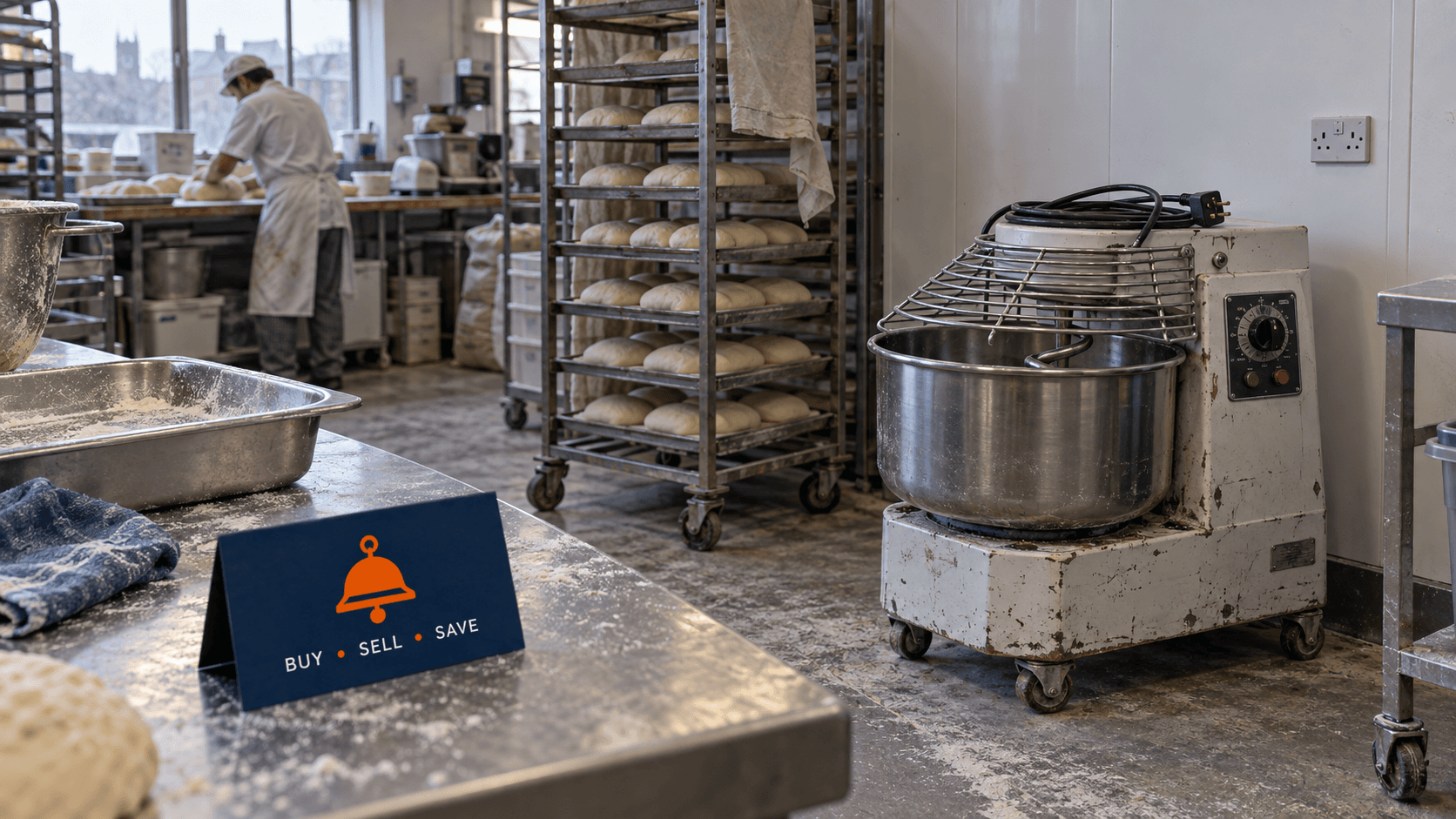
The person who knew that machine's quirks is the first thing you lose. Write down what they know before they leave, because a buyer will ask and a guess sounds like a guess.
Every bakery has a corner, and in most of them there is a piece of old bakery equipment standing in it. A spiral mixer that went quiet when the wholesale order went. A deck oven that came out when the new one went in. A prover nobody has switched on since the menu changed. It is not in the way enough to argue about, so it stays, and after a while you stop seeing it at all.
That is the expensive part. Standing there, the machine is not really losing condition. Bakery kit is built to outlast the businesses that buy it. What it is losing is the evidence that it works, and on second hand bakery equipment the evidence is most of the price.
A Bakery Machine Does Not Rust Away. Its Proof Does.
Two identical mixers, same make, same age, same hours. One is in a working bakery and can be switched on while somebody watches. The other is under a sheet in a lock-up and comes with a description.
They are not worth the same money, and the gap is not small. The first one sells for what it is. The second one sells for what a stranger is willing to gamble, which is always less, because the buyer is pricing in everything you cannot show them.
Twenty five years fitting and stripping out commercial kitchens teaches you one thing about the machine in the corner: it is almost never broken. It is just unproven, and unproven is what the trade pays less for.
What Goes Missing, And The Order It Goes In
This is the part nobody warns you about, because it happens slowly and none of it looks like a loss at the time.
The power goes first. The supply gets taken out with the old cook line, or the machine gets isolated, or the bakery moves and it does not get reconnected at the other end. From that moment every honest answer you give a buyer is a description instead of a demonstration.
Then the dough goes. A spiral mixer running empty proves the motor turns. It does not prove the gearbox is quiet under load, and quiet under load is exactly what a bread baker is listening for. That test only exists while there is still flour and water in the building.
Then the person goes. Whoever ran it every morning knew where it caught, what it sounded like when it was right, which speed the bakery actually used and which one it never touched. They move on, and all of that walks out with them.
Then the paper goes. Service sheets in a drawer that gets cleared. The manual that was on top of the machine. The wiring diagram taped inside the panel. Separate them from the machine and they become somebody's guess.
Last, the machine itself gets moved. Into the lock-up, behind the shelving, under a sheet with boxes on top. Now it cannot be photographed properly, cannot be reached, and cannot be viewed without somebody giving up a morning.
None of those steps costs you anything on the day. Together they are the difference between a machine that sells in a fortnight and a machine that sits.
Cleaning It Up Will Not Fill The Gap
The instinct, when you finally look at it properly, is to smarten it up. Degrease the seams, polish the bowl, get the flour out of the guard, maybe put a coat on the frame.
That is the cheapest thing you can do and very close to the least useful. It changes how the machine looks. It changes nothing a buyer can actually verify, and it invites the one question you do not want, which is what did you do to it and why did it need doing.
It is worth knowing that refurbished has no legal definition in the UK either, so a tidied machine described with that word is making a claim nobody has to stand behind. Experienced buyers know this. They discount a shiny machine with no history faster than they discount a scruffy one with a folder.
What To Do The Week You Stop Using It
There is one week when everything a buyer will ask for is still in the same building at the same time: the power, the ingredients, the person and the paperwork. That week is the window, and almost nobody uses it, because the machine has only just stopped and selling it feels like next month's problem.
Use it, and the job takes an hour.
Run it once more under a real load and record it. Dough in the bowl on a mixer, trays in on an oven, up to temperature on a prover. Short video, phone held steady, sound on, because the sound is half of what a buyer is judging.
Read the plate while you can still get behind it. Model and serial are on the sticker round the back or inside the panel on most bakery kit. Photograph the data plate and CaterBot fills the spec in for you, which saves typing out a listing for a machine you are not thinking about yet.
Write down what it actually ran on in your building, single phase or three phase, and what else was on that supply. This is the first question a serious buyer asks and the one that stops a wasted journey.
Ask whoever used it what it does when it is right, and write that down while they are still here to ask.
Then put the evidence where a buyer can read it, in the words of the listing rather than buried in a photograph. If you are ready to price it and get it out of the building, our seller's guide to bakery machines covers both, and the buyer's side of the same deal tells you what they will be checking when they arrive.
Before You Pull The Plug For The Last Time
- Run it under a real load and record it, while the power and the ingredients are both still here
- Photograph the data plate on the back or inside the panel while you can still reach it
- Write down the supply it ran on in your building, single phase or three phase
- Ask whoever used it daily what it does when it is running right, and write that down too
- Bag the service sheets, the manual and any special tools, and tape them to the machine
- Note what goes with it: bowls, hooks, spirals, trays, trolleys, and whether they are the originals
- Decide where it goes next before it goes in the corner of a lock-up
None of that is a day's work. It is the last hour of a machine's working life, spent on purpose instead of by accident, and it is worth more than any amount of cleaning. Do it and the thing in the corner stops being something you will deal with eventually and becomes something somebody else needs. That is what BUY • SELL • SAVE means on a machine like this one: a bakery somewhere gets kit it could not afford new, you get paid for something that was doing nothing, and the saving lands on both sides. It starts before the machine goes quiet, not after.
Ready To Find Out If Yours Will Sell?
Our free sell check tells you what a buyer will find missing, before they find it. CaterBids is a fixed price marketplace for new and used catering equipment, built for the UK trade, and we are in beta, so what is on it is real stock from real sellers. Your first listing is free, one per account, then listings start at £5, and there is no commission and no final value fee on what you sell.
Ready to Sell Your Equipment?
Your first listing is free, one per account, then from £5 for 30 days. No commission and no final value fee, so what a seller makes is what they keep.
Prepare Your Equipment
- Clean stainless surfaces
- Disconnect safely
- Photograph the data plate
- Box loose parts
- Measure and weigh
- Prepare for pallet collection