

Second Hand Chillers and Walk-In Coldrooms: The UK Buyer's Guide
Buying a second hand walk-in chiller or coldroom in the UK? Monoblock vs split, the R404A problem, panels, fire ratings and what it costs. CaterBids.uk
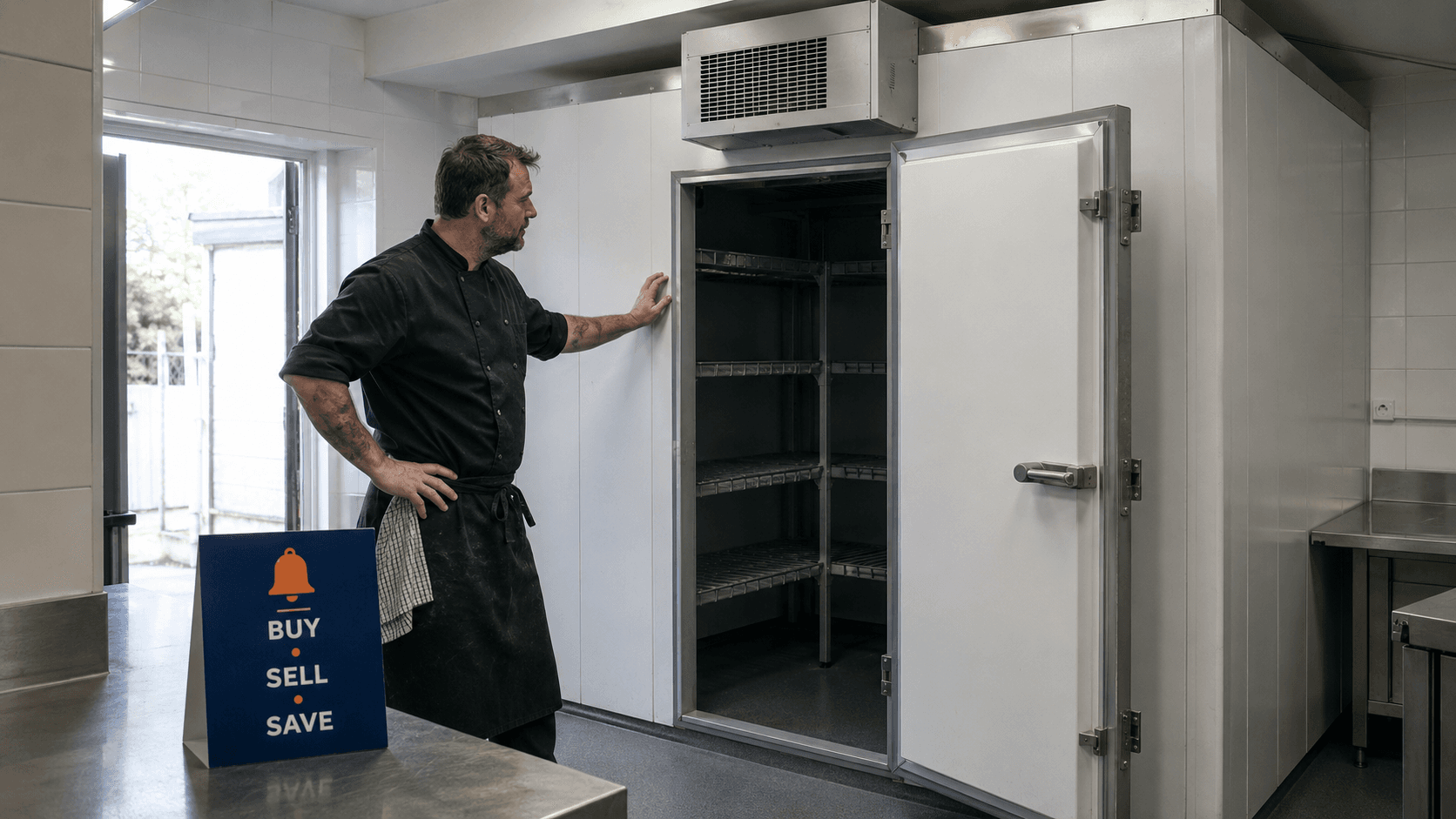
Ask one question before anything else: monoblock or split. A monoblock can be unbolted and moved. A split system needs an F-gas engineer at both ends, and that is a bill, not a favour.
This is the whole reason buying a used coldroom goes wrong. Everything else on a marketplace is a machine you plug in. A coldroom is four separate things bolted together: the panels, the door, the condensing unit and the evaporator. Any one of them can be the deal-breaker, and the three you cannot see properly are usually the expensive ones.
So before you look at the price, work through them in order.
Monoblock or Split: The Question That Decides Everything
Ask this first, because it changes what buying it actually costs you.
A monoblock unit is a single sealed refrigeration module that hangs through the wall of the room. It is charged with refrigerant at the factory and the circuit is never opened on site. One UK supplier states plainly that with a monoblock "the refrigerant is pre-charged at the factory, so the system is completely sealed, there's no on-site F-gas work required." That means the room can be unbolted, moved and reassembled, and the plant goes back on with an electrician rather than a refrigeration engineer.
A split system, with a remote condensing unit outside and an evaporator inside connected by pipework, is a different proposition entirely. Moving it means breaking into the refrigerant circuit. The gas has to be recovered by someone holding a current F-gas certificate before anything is disconnected, and it has to be recommissioned and leak tested at the other end. That is two engineer visits, and it is a bill, not a favour.
Neither is better. But a cheap split system twenty miles away is not the same purchase as a cheap monoblock twenty miles away, and the difference is not on the advert.
The Refrigerant Question, and Why R404A Matters
Most older commercial coldrooms in the UK run on R404A, and there is a rule about it that catches people out.
Since 2020 it has been prohibited to use virgin F-gases with a global warming potential of 2500 or more, which includes R404A, to service or maintain existing refrigeration equipment with a charge of 40 tonnes CO2 equivalent or more. Reclaimed or recycled gas of the same type can still be used to top up, and that option runs until 2030.
Read that carefully, because two things follow from it.
First, most catering-sized coldrooms sit well below the 40 tonne threshold, so a small room on R404A can still be legally serviced on virgin gas today. The ban bites on large systems, supermarket packs and industrial plant.
Second, and more usefully: the whole direction of travel is one way. The GB phase-down currently allows 31% of the baseline quota through to the end of 2026, dropping to 24% from January 2027, and DEFRA confirmed in May 2026 that it will not legislate this year to change those steps. Less quota means dearer gas. A big system on R404A is a system whose running costs go up rather than down, and it is worth pricing a regas into the offer.
Northern Ireland is a separate case. Under the Windsor Framework it continues to apply the newer EU F-gas regulation, which is stricter than the GB regime, so an NI buyer and a GB buyer are not under the same rules.
What the Law Puts on You as the Owner
Three duties sit on the equipment owner, not on the engineer, and they apply the moment you own it.
Leak checking is by charge size. Systems containing 5 to under 50 tonnes CO2 equivalent are checked at least every 12 months, 50 to under 500 at least every 6 months, and 500 or more at least every 3 months. Fit an automatic leak detection system and you can double the interval. Detection is compulsory at 500 tonnes or more. Hermetically sealed systems are exempt unless they hold 10 tonnes or more, which is why a small monoblock usually falls outside the regime entirely.
Records must be kept for at least five years, and the record duty applies to equipment holding 5 tonnes CO2 equivalent or more.
Recovery before disposal is mandatory, by someone holding a current F-gas certificate, and there is no minimum charge size on that one at all. The published maximum civil penalty for failing to recover is £100,000, and the same maximum applies to venting gas deliberately.
On who can touch it: individual engineers hold F-gas certificates in four categories, and for most coldroom work you want Category 1, which covers all activities, or Category 2 for systems under 3kg of charge. Companies servicing other people's equipment must hold a company certificate from an approved body, currently Refcom, F-Gas Register or Bureau Veritas. Ask for the certificate number before the engineer arrives, not after.
Panels: What You Are Actually Buying
Coldroom panels are modular, cam-locked together, with an insulating core between two steel skins. What matters second hand is the core, the thickness and the condition of the skins.
On thickness, UK suppliers publish broadly consistent figures: around 80mm for a chiller and 120mm for a freezer, rising to 150mm for anything below minus 25. A freezer room built on chiller-thickness panels will run, but it will run its compressor into the ground trying.
On condition, look for what you cannot fix cheaply. Delaminated panels where the skin has parted from the core, water ingress into the insulation, which is heavy, invisible from outside and permanent, damaged cam locks that will never pull a tight joint again, and corroded skins around the floor line where the mop has lived for fifteen years. Check the door hardest of all: hinges, the seal, and on a freezer the heated frame that stops it icing itself shut.
Floor or floorless matters too. A floorless room sits on your existing screed, which is cheaper and fine for a chiller, but a freezer without an insulated floor will freeze the slab beneath it and eventually heave it.
Fire, and What Your Insurer Thinks About It
This is the part nobody tells second hand buyers and it can cost you cover.
Insulated panel cores are not all the same. Expanded polystyrene and polyurethane are combustible and are the fire risk in cold storage. Polyisocyanurate and mineral wool are the fire-retardant alternatives. Insurance guidance recommends panels certified by the Loss Prevention Certification Board to standards such as LPS 1181 or LPS 1208, and warns that premises using combustible panels "may face higher premiums or restricted coverage because of the risks involved."
So on a used room, find out what the core is before you buy, and tell your insurer what you are putting in. Discovering the answer after a claim is the expensive order to do it in.
Blast Chillers Are a Different Machine Entirely
Worth separating, because they get lumped in with chillers on adverts and they are not the same thing.
A blast chiller is built to hit a performance standard, not just to hold a temperature. Department of Health guidance is that food must be reduced from +70°C to +3°C or below within 90 minutes. Blast freezing is +70°C to minus 18°C within 240 minutes. That is what the machine is for, and it is the only thing worth testing on a used one.
So do not buy a blast chiller on the strength of it getting cold. Load it and time it. A tired unit that holds temperature happily can still fail the 90 minute run, and a blast chiller that cannot hit its cycle is an expensive fridge.
What It Costs
For context on new, from UK suppliers in 2026: small self-contained chiller rooms start around £2,900 for a 1.2 metre square room and run to about £6,200 for a three metre square one, with freezer rooms of the same footprint a few hundred to a thousand pounds more. Installed walk-in freezers with a split system, panels, insulated floor, door heaters, lighting, controls, commissioning and a twelve month warranty are quoted from about £5,500 for a two metre square room up to £14,000 for five by four metres.
Those are vendor list figures rather than an independent index, but they set the benchmark the used market has to beat. And the honest arithmetic on a used room is the same as everywhere else in this trade: the number that matters is the price plus what it costs to move it, plus the engineer at both ends if it is a split, plus any regas. A £1,000 room that needs £1,500 of that is not a £1,000 room. Our guide on where catering spares actually come from covers how to check a badge has parts behind it before you commit.
If you are looking at cabinets rather than rooms, the complete guide to used commercial refrigeration covers uprights, prep counters and display, which are a different buy again. And if the condensing unit needs a dedicated supply, three phase and single phase catering equipment explains how to work out what your kitchen actually has.
The Checklist for a Second Hand Coldroom
- Monoblock or split? It decides the whole cost of moving it
- What refrigerant, and what is the charge? R404A above 40 tonnes CO2e cannot be topped up on virgin gas
- Get the F-gas certificate number of whoever will recover and recommission it, before you buy
- Walk the panels: delamination, wet insulation, damaged cam locks, corroded floor line
- Check the door, seal, hinges and the heated frame on a freezer
- Floor or floorless, and is it right for chill or freeze
- Find out the panel core and tell your insurer before it is installed
- On a blast chiller, load it and time the cycle. Holding cold is not the same as blast chilling
- Price the move, the engineer at both ends and any regas into your offer
BUY • SELL • SAVE
A coldroom is the most reusable thing in a commercial kitchen. Panels last decades, doors can be rebuilt, and a condensing unit is a serviceable machine. Bought with the four parts checked separately, a second hand room is the best value in the whole trade. Bought as one lump on a photograph, it is a very heavy mistake to move twice.
Ready to Buy or Sell?
Browse the marketplace for used commercial refrigeration, or if you have a coldroom, condensing unit or blast chiller coming out of a site, list it on CaterBids. Your first listing is free while our launch offer lasts, then from £5 for 30 days. No commission and no final value fee.
Ready to Sell Your Equipment?
Your first listing is free while our launch offer lasts, then from £5 for 30 days. No commission and no final value fee, so what a seller makes is what they keep.
Prepare Your Equipment
- Clean stainless surfaces
- Disconnect safely
- Photograph the data plate
- Box loose parts
- Measure and weigh
- Prepare for pallet collection